This has been in my drafts for 6 years now but it could have been written today because everything in it still resonates. I’m posting it now so it’s easier to find when I no doubt will feel similar again in the future.
“This is my apology to friends who have sent me messages recently that I either haven’t replied to yet or that took me a very long time to reply to… I’ve been in hiding mode.
For the long apology read on. For the short apology: I’m so sorry, I’m trying to pull myself out of hiding and catch up with you all.
My closest friends will probably recognise that I do this every now and again. I’ll suddenly be even more crap at replying to messages than normal – sometimes it’s weeks or months before I respond. Or I’ll not make plans with you, or make it out the house to meet up if we do. And I want to say I’m truly sorry for when I do that; I genuinely love and appreciate your friendship but I’ve gone into hibernate mode and hidden myself away.
Sometimes I hide away because I’m mentally and physically exhausted and just getting up and surviving the day is all I can achieve.
Sometimes I hide because I don’t know how to answer the inevitable question of ‘what have you been up to?’
Sometimes I hide because I’m overwhelmed with things to do yet I can’t seem to work out where to start.
Sometimes I hide because being in the real world surrounded by people reminds me that in my world I feel alone.
Sometimes I hide because I’ve just lost interest in everything for no reason and I don’t want to bring anyone else down.
And sometimes I haven’t worked out the reason why, it just happens.”
What I want you to know:
If I’m rubbish at replying to your message, or I haven’t seen you in ages, please know that I do love you and I’m grateful for your friendship but I’m probably in hiding for one or more of the reasons above until I sort my own head out and I hope you understand.
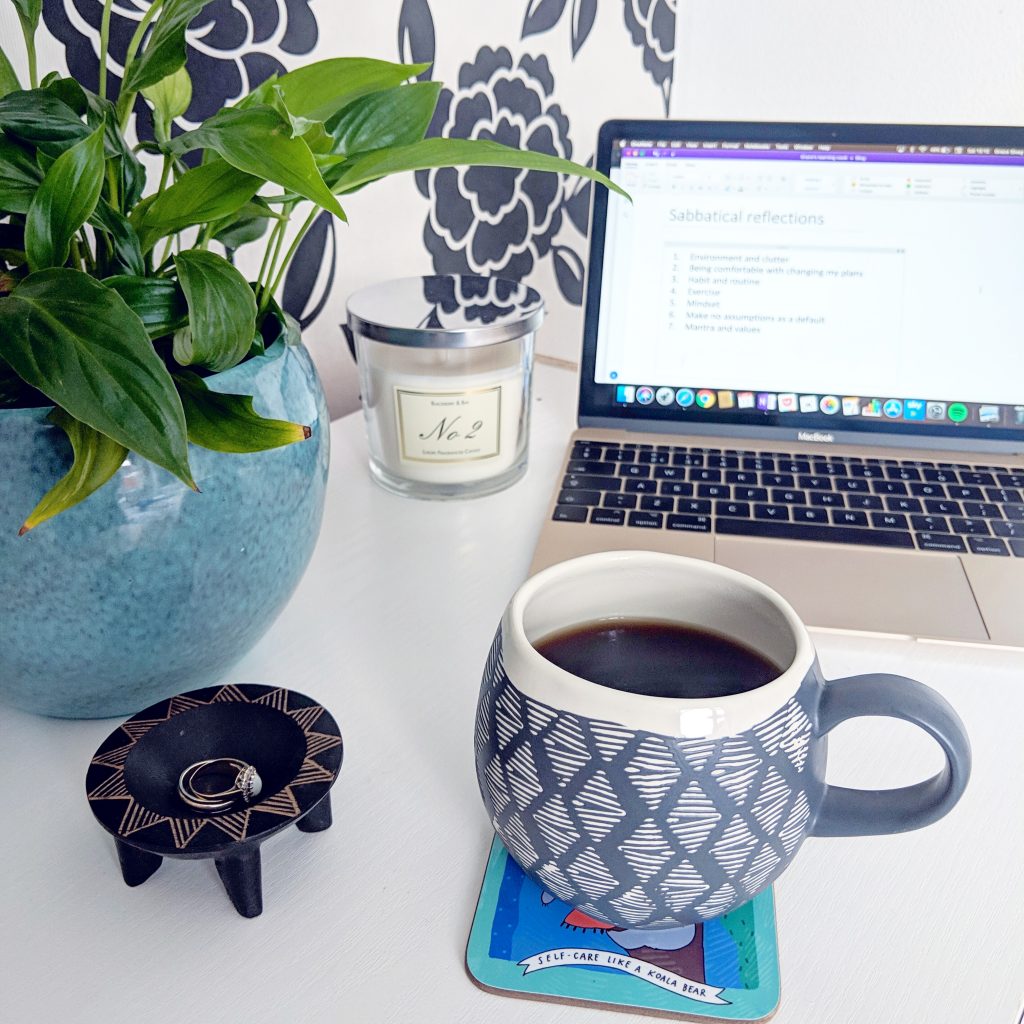
I’m two weeks back into full time work and I’ve tried to write this blog a few times in the past month but have struggled to condense my year’s worth of learning about myself into something short enough to digest. This isn’t as succinct as I’d like but these are the 7 things that have come to my mind first when I’m asked about my year off so I guess that means they’ve all had a big impact on my life. They are learnings that I want to take with me and remember going back into work and beyond, so this is as much of a note to my future self as it is to anyone else who’s interested in what I’ve learned!
1. The environment around me significantly affects my ability to function, concentrate and think.
I noticed pretty quickly after I finished work that I needed both a clear physical and mental environment before I could actually be productive. Perhaps naively, I thought I would finish work and straight away I would have all the time in the world to do the things I’d set out to do. However, because I still had lots of things on my mind and had tidy-yet-somewhat-cluttered spaces in my home I couldn’t concentrate properly on reading or learning. Cue a massive decluttering spree that Marie Kondo would be proud of I’m sure. So I now know I feel much calmer, relaxed and more able to focus when I have a clearer space around me (physically and online). I’ve also set up a OneNote for my life so that when I have things cluttering up my head I can stick it on the relevant list to do, or think about, later; that way everything is all in one place and I can get on with my day and not worry that I’ll forget about it.
To remember:
Make sure you invest a little bit of time keeping your physical, online and mental environments clutter-free and you will feel calmer and more able to focus.
2. It’s okay if I change my own plans.
This one has been a tough lesson for me. I’m not much of a planner usually but if I do say to myself I’m going to do something I’m pretty stubborn with myself and always feel like I absolutely have to do it. This year I had many plans of learning, reading, volunteering and travel. I’ve probably only achieved half of what I set out to do, but I’m learning to be okay with that because I’ve still achieved a lot. I’ve done some online courses, I’ve read a lot, I’ve had a few holidays but more than anything I’ve learned about myself and I might not have learned the things I have if I had been focused on getting the original things done just because I felt like I had to.
To remember:
Don’t stress yourself out by thinking you have to stick to something just because you said you would. If the reasons why you want to (or don’t want to) do something have changed that’s completely fine.
3. Habits rule all.
It may sound boring but sticking to a routine, even when I don’t have to, and creating good habits is key to me being productive and achieving my goals. When I first finished work last year I just enjoyed doing things when I wanted to, but after a couple of weeks I realised I wasn’t really making progress on my goals and time was getting away from me. So I sat down and wrote down a daily routine to give myself some structure. I found this incredibly helpful in making sure I could balance all the mundane tasks that needed doing, the more enjoyable, relaxing things, as well as doing reading and learning that I’d set out to do. I also created new habits like watching a TED talk with my morning coffee to inspire me for the day ahead- this has become such an automatic routine in my day now that I’ve kept it up since starting back at work. I’ve also learned a lot about habits not just from my own experience but from ‘The Power of Habit’ by Charles Duhigg which is a brilliant read.
To remember:
Making good habits and giving yourself a routine to follow will help you be productive. Give yourself the time to set them up in the first place and stick with them until they become automatic.
4. Everything in life is an opportunity to learn.
I’ve worked on my mindset a lot this year. I’ve often been told that I appear to be a really positive person but inside my own head things don’t always play out in a positive way, and like many people I worry a lot and can have a cynical default setting. But having read quite a bit on how mindset really does impact on how we feel about many aspects of our lives I’ve switched my default setting to see everything as an opportunity for growth and learning. This has been quite a hard one for me, and I’m sure it’ll be a challenge to take forward in a work environment, but the more I practice seeing opportunities to learn rather than a success or failure the more I hope this will become a self-fulfilling prophecy. Linked to this is a phrase I read in a book recently – ‘life is not a zero sum game’ – and it’s stuck with me. What others around me are doing or not doing should have no bearing on me.
To remember:
Life is on a continuum not a two-point scale.
Everything is an opportunity to learn and grow.
5. Exercise is as good for me mentally as it is for me physically.
This is probably an obvious one but I honestly didn’t believe the impact it could have until I made exercise a habit. This has been a slowly developing realisation after doing various home workout programmes the past few years but I truly began to believe it when I started personal training. I’ve never been one to get that rush of endorphins people talk about after physical exercise but I have started getting feelings of being proud of myself for what I can do. My PT has always had faith in me when I didn’t have it myself to do certain movements or use certain weights and that’s helped me over time to build my own confidence. I love seeing the small steps of progress I make in the gym and that’s taught me so much about enjoying the journey rather than just focusing on the end goal. And this approach to physical progress has transferred over into the way I approach many other things in life now (see learning no 4 above 🙂 ). In addition, spending time doing exercise gives my mind the space to wind down and relax. This has helped me in particular after my second day back at work where I felt overloaded and overwhelmed with information, I was tired and had about an hour free between finishing work and meeting colleagues for dinner. Even a year ago I would have defaulted to watching TV thinking that would help me relax but instead my habit kicked in and I did a quick workout. I came out the gym feeling like a different person and with a much clearer head.
To remember:
Enjoy the journey and celebrate small steps.
Even if you’re tired, go and do a workout and you will feel the benefit of a clearer mind.
6. Assume nothing.
I’m learning to make no assumptions and no judgements about anyone. It’s always annoyed me when people make assumptions about me before they really know me, but I’ve definitely been guilty of doing it to others in the past. Maybe it’s to do with my approach to living life more slowly now but I think I’ve been better at recognising when I do this and challenging myself to find out more information before having an opinion. You really don’t know what someone else is going/has gone through unless you’ve asked them, yet we all make quick judgements which essentially are made up of assumptions. So I’ve tried to make ‘assume nothing’ my default and that way it also encourages me to find out more about the person.
To remember:
Assume nothing until you know more.
7. Stay true to your mantra.
Another mental trick I’ve picked up is to have my own mantra to live by (I know, cliché and all). It’s pretty much a very short summary of the values I hold of how I want to live my life but in a succinct enough phrase that I can easily remember it! Now when opportunities, or anything really, crops up my mantra pops into my head and it’s easy for me to do a quick check to see whether the opportunity or thing is aligned to my values.
To remember:
Your mantra is there to help and remind you of what’s important.
I’ve started a new routine of watching a TED talk with my morning coffee.
I don’t do anything else other than listen, watch and drink. In a way it’s my nod to mindfulness; for me to be able to start a new day really listening and focusing on an interesting video and the taste of coffee sets my day off in a calming way. In these few minutes if I have any thoughts about what I need to do that day, where I’m going later or what shopping I need to get, I am now aware that my mind has strayed and I rewind the video a couple of seconds and get right back into the talk.
This morning’s entertainment was a talk on how powerful taking time off work can be (scroll down for video).
Within a few words Stefan Sagmeister managed to convey exactly my gut feeling on why it is important to sometimes take a step out and change focus for a while, and why I’m currently on a sabbatical myself.
I’ve long since referred to my break as my ‘early retirement’ so hearing Stefan explain exactly that concept – taking off some years from retirement and interspersing them throughout his working life – hit the nail on the head for me.
What I learned from this talk:
1. Without a plan you can just react to life, which may be good and enjoyable but it also may be more helpful to still plan your time.
I realised this myself after a couple of months of no routine and no plan, just doing what I wanted, when I wanted. I was enjoying my time off but I didn’t feel very productive. It was only when I set myself a daily routine (just like a school timetable!) that I felt I was being more efficient with my learning. Even though I was roughly still doing the same things as before I became more aware of the progress I was making after structuring my day.
2. You may not fully appreciate the importance of an experience or knowledge straight away.
Sometimes I may not be getting the full benefit of what I’m learning on my break whilst I’m on it but it may influence my work and life for years to come – similar to how Stefan’s following 7 years’ worth of ideas stemmed from his sabbatical.
3. You won’t know whether a risk is worth it until you try.
It’s quite a risk stepping out of your working life to take time to do something just for yourself; how will it effect my career, what might a gap look like on your CV etc. When I requested my break I’m not sure I really knew many (if any) people who had taken a sabbatical for something like personal development. Before when I had come across people who had taken a career break it was for a specific purpose such as to travel or to undertake a degree. Although I knew the purpose of my break was to develop my knowledge on certain topics, to me it didn’t feel a valid reason enough because it wasn’t an academic course or a finite period of travel. I felt as though I was going against the grain and not following a ‘normal’ career path so it was a risk for me to even ask for it and how my work might react.
But now I have learnt an incredible amount about myself and the topics I’m interested in that I’m not as worried about the impact on my career because I know this time has been invaluable to me and what I offer to the working world – yet I wouldn’t know this or have expanded my knowledge had I not taken a risk to ask for a break in the first place.